Teltonika industrial routers: RUTM50, RUTC50, RUT956, RUT241 and TRB140
Teltonika's industrial range still runs from a compact LTE gateway up to a 5G dual-SIM router with a full local network edge. What has changed is the 5G starting point. Teltonika has announced that the RUTX series is end of life, and has listed RUTM50 and RUTC50 as the replacements for RUTX50. This guide therefore starts with those two 5G routers, then covers RUT956 and RUT241 for LTE field work, and TRB140 when a compact gateway is enough. The checks that prevent a bad order code — bands, antennas, power, I/O and RMS ownership — have not gone away.
The earlier FUSE article, updated 22 August 2026, is still useful on roles and RMS, but it still leads with RUTX50. Use this page for a current 5G shortlist, and see RUTX50 vs RUTM50 vs RUTC50 for the replacement map.
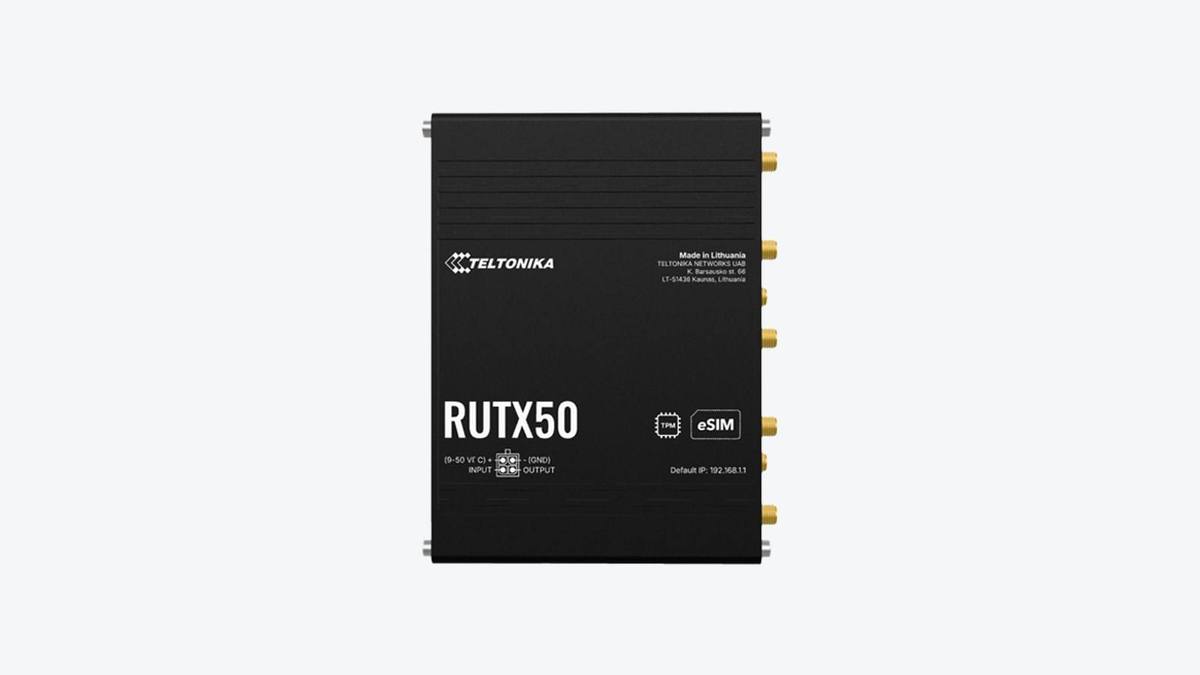
The bottom line
If the site has a real 5G requirement, specify RUTC50 for the higher-performance path (Wi-Fi 6, 1 GB RAM, 8 GB flash, dual SIM and eSIM) or RUTM50 as the like-for-like RUTM-series path after the regional order code is confirmed. If the traffic is telemetry, remote administration or modest control, a well-sited LTE design with RUT956 or RUT241 is often enough. If a single device only needs a cellular path, look at TRB140 before you buy a full router.
Start with the role: router, gateway or switch
An industrial router sits between a cellular WAN and a local Ethernet, Wi-Fi or device network, and supplies routing, firewalling and often Wi-Fi or several LAN ports. A compact gateway gives one device or a small Ethernet segment a cellular path, with a smaller footprint. A switch expands local wired connectivity; it does not replace the WAN router. Choose the role from the endpoints, VLANs, serial or I/O needs and the management method, not from a model name.
Teltonika describes the TRB140 as a compact industrial LTE gateway with Gigabit Ethernet, Micro-USB and RutOS. That is a practical candidate for a single controller, cabinet or remote device. FUSE product page.
RUTM50 and RUTC50: the current 5G starting point
Both models are 5G routers with five Ethernet ports and dual SIM, according to Teltonika's product pages and wiki Interfaces documents. Headline cellular speeds are given as up to 3.4 Gbps. Differences that should drive the choice:
- RUTC50 — dual-band Wi-Fi 6, 1 GB RAM, 8 GB flash, dual SIM and eSIM, described by Teltonika as a compact 5G router for edge and mission-critical operations. Browse the Teltonika hub.
- RUTM50 — dual SIM auto-failover, WAN backup, dual-band Wi-Fi, and a like-for-like replacement role for RUTX50. Confirm the regional order code: the wiki currently introduces the model as a North America router, while the certification page also lists CE/RED and UKCA. FUSE product page.
The RUTX50 remains on Teltonika's EOL list and may still appear in stock. Treat it as a supported but end-of-life option, not as the default 5G router for a new design. FUSE product page. Source: EOL announcement for the RUTX-series (3 August 2026).
Do not buy 5G only because a coverage map shows it. Verify the destination's bands, a signal or antenna plan, the SIM product, and the device's regional order code.
RUT956 and RUT241: LTE for field and compact deployments
RUT956 is the 4G/LTE router to consider when the install needs industrial I/O and serial connectivity as well as routing. Teltonika's wiki describes four Ethernet ports, Wi-Fi, dual SIM, GPS/GNSS, an I/O connector block, RS232/RS485 and RutOS. FUSE product page.
RUT241 is the compact 4G/LTE router: two Ethernet ports, Wi-Fi and RutOS, according to the wiki. It is the shorter list when the site does not need the RUT956's serial interfaces, extra Ethernet or second SIM. Quote it from the Teltonika brand hub or a project enquiry.
Confirm the order code, carrier bands and any operator requirement for the destination. Specify power, mounting, grounding and the enclosure with the same care as the router itself.
OTD140, when the router has to live outdoors
For an outdoor 4G install, Teltonika's OTD140 uses an IP55 plastic housing, an integrated mounting bracket, LTE Cat 4, RMS, and two PoE-in/out Ethernet ports. Wiki. FUSE product page.
RMS and remote operations must be designed, not assumed
Teltonika RMS can gather status and change configuration even when devices do not have public IP addresses. That is useful for distributed sites, but it is not a substitute for a support model. Decide who owns the RMS tenant, device groups, administrator roles, templates, alerts, firmware approval and offboarding before devices are commissioned. Use unique administrator accounts and a documented recovery procedure for SIM, APN and failed firmware updates.
A deployment checklist before ordering
Capture the country, carrier, expected bands, signal environment, required uptime, local devices, VPN or cloud destination, IP addressing, power, mounting and enclosure conditions. Then select the router or gateway with enough interfaces and enough lifecycle headroom. A model name alone does not prove that a particular SIM, antenna, country profile or application will work.
YOT LTD can help turn that discovery into an orderable bill of materials for Malta and wider EU deployments, including the router or gateway, antennas, power and accessories. For a mixed satellite and cellular design that needs bonding rather than failover, also see Peplink vs Teltonika and the yacht router guide.
Where to buy
YOT LTD is a Teltonika supplier in Malta. Check the FUSE Teltonika hub or Buy Teltonika in Malta. Email sales@yotltd.com or call +356 2732 7840. YOT LTD, C93877, 31, Triq l-Imdina, Ħ'Attard ATD9039.
Sources
- https://www.teltonika-networks.com/newsroom/eol-announcement-for-the-rutx-series
- https://www.teltonika-networks.com/products/routers/rutm50, /rutc50, /rutx50
- https://wiki.teltonika-networks.com/view/RUTM50, RUTC50, RUTX50, RUT956, RUT241, TRB140, OTD140
- https://www.fuse.systems/guides/teltonika-industrial-router-guide
Frequently asked questions
Which Teltonika router should I choose for industrial 5G?
What is the difference between a Teltonika router and a TRB140 gateway?
Does RUT956 support serial and I/O connectivity?
Can Teltonika devices be managed without a public IP address?
Do I need 5G for remote monitoring?
Can YOT help specify Teltonika equipment for a Malta or EU project?
Continue the topic
Related reading
- Teltonika RUTX50 vs RUTM50 vs RUTC50: which 5G router to specify nowThe RUTX50 is end of life. Teltonika lists RUTM50 and RUTC50 as its replacements. Here is how the three models compare, and which to specify for a new project.8 min read
- Teltonika routers for yachts and boats: failover, antennas and RMSA Teltonika router is a strong onboard cellular path when you need dual-SIM failover, industrial hardware and remote management. It is not a substitute for Peplink SpeedFusion bonding. Here is how to specify the job.8 min read
- Teltonika Networks: resilient cellular connectivity at the edgeDual-SIM industrial routers, RutOS management and failover design, how Teltonika keeps vessels, sites and remote assets online.6 min read